
Interesting prices on some Lincoln Cents
This is a price list from the 1950’s. Check the price of 1909-S VDB. Simpler times. One Uncirculated classification.
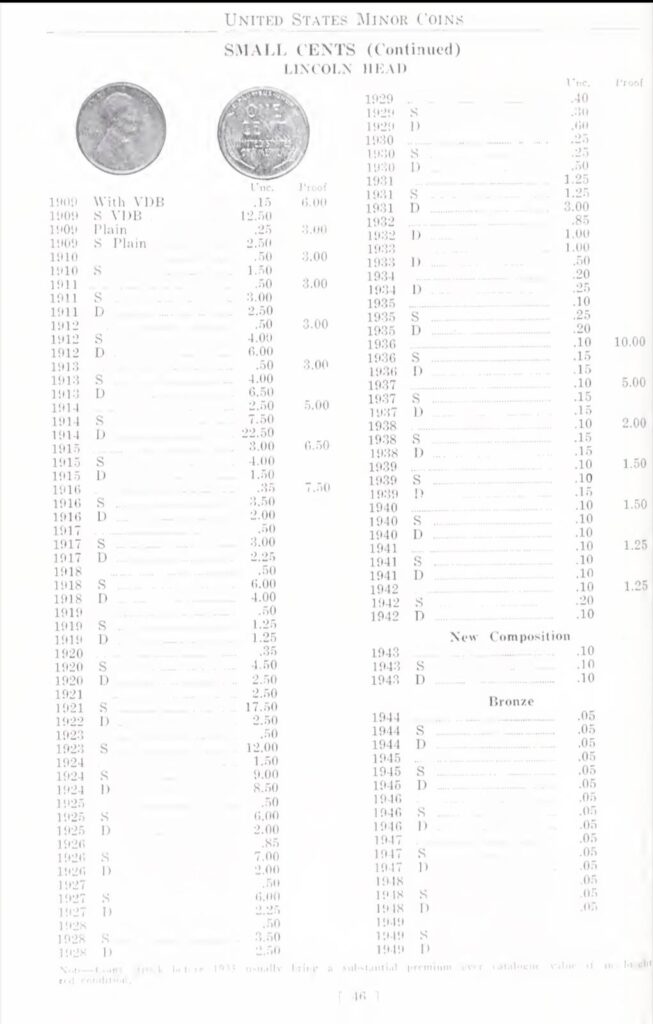
This is a price list from the 1950’s. Check the price of 1909-S VDB. Simpler times. One Uncirculated classification.
Doubled die coins occur when the die itself receives multiple design impressions from a master hub with a slight misalignment, not during the striking of the coin itself. Numismatists classify these mint errors into eight distinct classes based on how the misalignment occurs: The 1955 Lincoln Cent Doubled Die (Class I) is the most famous…
The Morgan Dollar, minted from 1878 to 1904 and again in 1921, holds a unique place in American numismatics. Struck in vast quantities to satisfy the demands of silver interests under laws like the Bland-Allison Act and later the Sherman Silver Purchase Act, the coin was never particularly popular in everyday commerce. It was large,…
If you answered 15, you were right for all of your life, until August 12, 2025. The new correct answer is 16! The 1804 Silver Dollar, often called “The King of American Coins,” is one of the most famous and valuable coins in U.S. numismatics. Despite its date, none were struck in 1804—most were minted…
UNTED STATES MINT FACILITIES I. PHILADELPHIA MINT: P 1792 Congress passes the ‘Coinage Act’ authorizing the creation of a mint to manufacture coins representing American denominations (dollars and cents) to be used in place of coinage from other nations. Philadelphia, the first capitol of the United States is chosen as the mint’s location. The mint…
In May 2025, the U.S. Mint announced it had placed its final order for penny blanks, signaling the beginning of the end for the one-cent coin. While no official law has been passed to eliminate the penny entirely, the Mint confirmed that production will cease once the current supply of blanks is exhausted—expected in early…
MINT ERRORS When we speak of mint errors, some people will think of doubled dies (DDO’s & DDR’s), re-punched mint marks (RPM’s), and over mint marks (OMM’s). Doubled Dies are errors related to die creation whereas RPM’s and OMM’s are human errors cause by the manual process adding a mint mark to an existing die. …