Forgotten Voices in Metal: The Overlooked World of Hard Times, Civil War, and Merchant Tokens
When most collectors think about American numismatics, their minds drift naturally toward the great government series — Morgan dollars, Walking Liberty halves, Buffalo nickels, and early bust coinage. Foreign coins draw their share of admirers too, with centuries of royal portraiture and exotic scripts lending an air of the exotic. But tucked quietly between these celebrated categories lies a collecting field that is, arguably, far richer in raw American history: the world of privately issued tokens. Hard Times tokens, Civil War tokens, and 19th-century merchant tokens tell the story of ordinary American life at its most turbulent — not through the sanitized symbolism of official coinage, but through the voices of shopkeepers, patriots, satirists, and opportunists who needed small change and weren’t willing to wait for the government to provide it.
Hard Times tokens emerged from the economic chaos that followed Andrew Jackson’s war on the Second Bank of the United States. From roughly 1832 to 1844, a collapse in credit, a flood of wildcat bank notes of dubious value, and a hoarding of silver and copper coins left everyday Americans scrambling for small change. Private issuers stepped in. The result is a series of small copper tokens — many the size of a large cent — that are equal parts commerce and political commentary. Some are straightforward store cards advertising a merchant’s goods and address. Others are biting political satire, mocking Jackson as a tyrant or lampooning the economic catastrophe his policies helped create. A famous type shows a jackass on one side — a not-so-subtle commentary on the president — while others depict a tortoise carrying a safe, a sly reference to the sluggish pace of Martin Van Buren’s economic reforms. Collectors today can find these pieces for modest sums, yet each one is a window into a forgotten economic crisis that shook the young Republic to its core.
The Civil War token series, struck between roughly 1861 and 1864, arose from a different kind of desperation. When the war began, citizens hoarded coins — gold, silver, and even copper cents — out of fear and uncertainty. Small change virtually vanished from commerce. Merchants across the Union responded by issuing their own one-cent-sized copper tokens, accepted locally in place of government coinage. By the time Congress cracked down in 1864, an estimated 25 million Civil War tokens had entered circulation across thousands of different varieties. They divide broadly into two categories: store cards, which advertise a specific merchant with name, city, and trade; and patriotic tokens, which carry political and military slogans, portraits of Lincoln, eagle devices, and battle cries of the Union cause. Some are touchingly simple — a blacksmith in rural Ohio, a druggist in Manhattan — while others carry the passionate rhetoric of a nation at war. A few Confederate-sympathizing tokens exist as well, though they are far rarer. The Fuld reference catalogue — the bible of the series, compiled by George and Melvin Fuld — lists over 10,000 varieties, yet even advanced collectors regularly encounter unlisted pieces. The thrill of attribution, of connecting a token back to a specific shop on a specific street in the 1860s, is one the series offers in abundance.
Merchant tokens more broadly — a category that extends from the mid-19th century well into the early 20th — represent the long tail of private commerce in an era when small change was perpetually scarce or unreliable. Issued by saloons, dry goods stores, streetcar companies, dairies, and general stores, these pieces were redeemable for specific goods or services and rarely circulated beyond a few city blocks. They are the archaeological record of American retail life: the neighborhood butcher who gave a brass “good for 5¢ in trade” token to encourage loyalty, the mining company that paid its workers in scrip redeemable only at the company store, the ferry operator who pressed tin tokens to speed boarding. The Low and Rulau reference works catalogue thousands of these pieces, but the field remains only partially documented, and new discoveries are common. Many can still be acquired for just a few dollars — less than the price of a cup of coffee — despite their genuine historical significance.
For this collector, the journey into Civil War tokens took on an unexpected personal dimension. While searching for store cards connected to my own profession as an ophthalmologist, I encountered the tokens of H.D. Higgins of Mishawaka, Indiana — an optician who pressed copper Civil War tokens to keep his shop running during the national emergency of the 1860s. That small biographical thread was enough to transform an already fascinating series into something that felt genuinely personal. Here was a 19th-century eye care practitioner, working in a small Indiana town while the country tore itself apart, solving the same mundane problem every other merchant faced: how do you make change when there is no change to be made? His tokens survive today, attributable to a specific man at a specific address, and that human connection is something no Morgan dollar — however beautiful — can quite replicate.
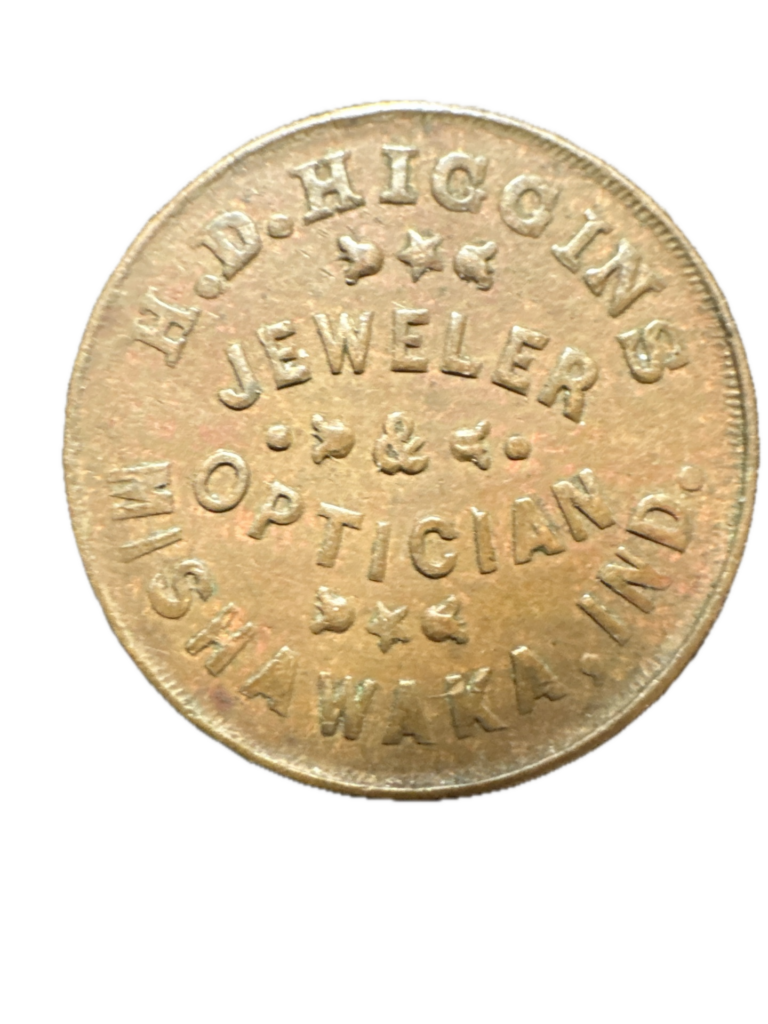
For this collector, the journey into Civil War tokens took on an unexpected personal dimension. While searching for store cards connected to my own profession as an ophthalmologist, I encountered the tokens of H.D. Higgins of Mishawaka, Indiana — an optician who pressed copper Civil War tokens to keep his shop running during the national emergency of the 1860s. That small biographical thread was enough to transform an already fascinating series into something that felt genuinely personal. Here was a 19th-century eye care practitioner, working in a small Indiana town while the country tore itself apart, solving the same mundane problem every other merchant faced: how do you make change when there is no change to be made? His tokens survive today, attributable to a specific man at a specific address, and that human connection is something no Morgan dollar — however beautiful — can quite replicate.
What unites these three series is precisely what keeps them underappreciated in the broader marketplace: they require work. Attributing a Civil War store card to its issuer, reading an archaic merchant’s advertisement, or placing a Hard Times political token in its historical context demands more of the collector than simply looking up a date and mint mark in a price guide. But for those willing to engage, these tokens reward the effort handsomely. They connect the collector not to the abstract machinery of government mints but to real people — merchants, mechanics, farmers, and soldiers — living through some of the most dramatic chapters in American history. A Morgan dollar is beautiful. A Civil War token from a New York coppersmith, struck in the year Lincoln signed the Emancipation Proclamation, is a piece of that moment itself. The coins that history forgot may well be the most interesting coins of all.